2002 - 2026  Copyright ©


Trincheiras

Rio de Janeiro, 2018
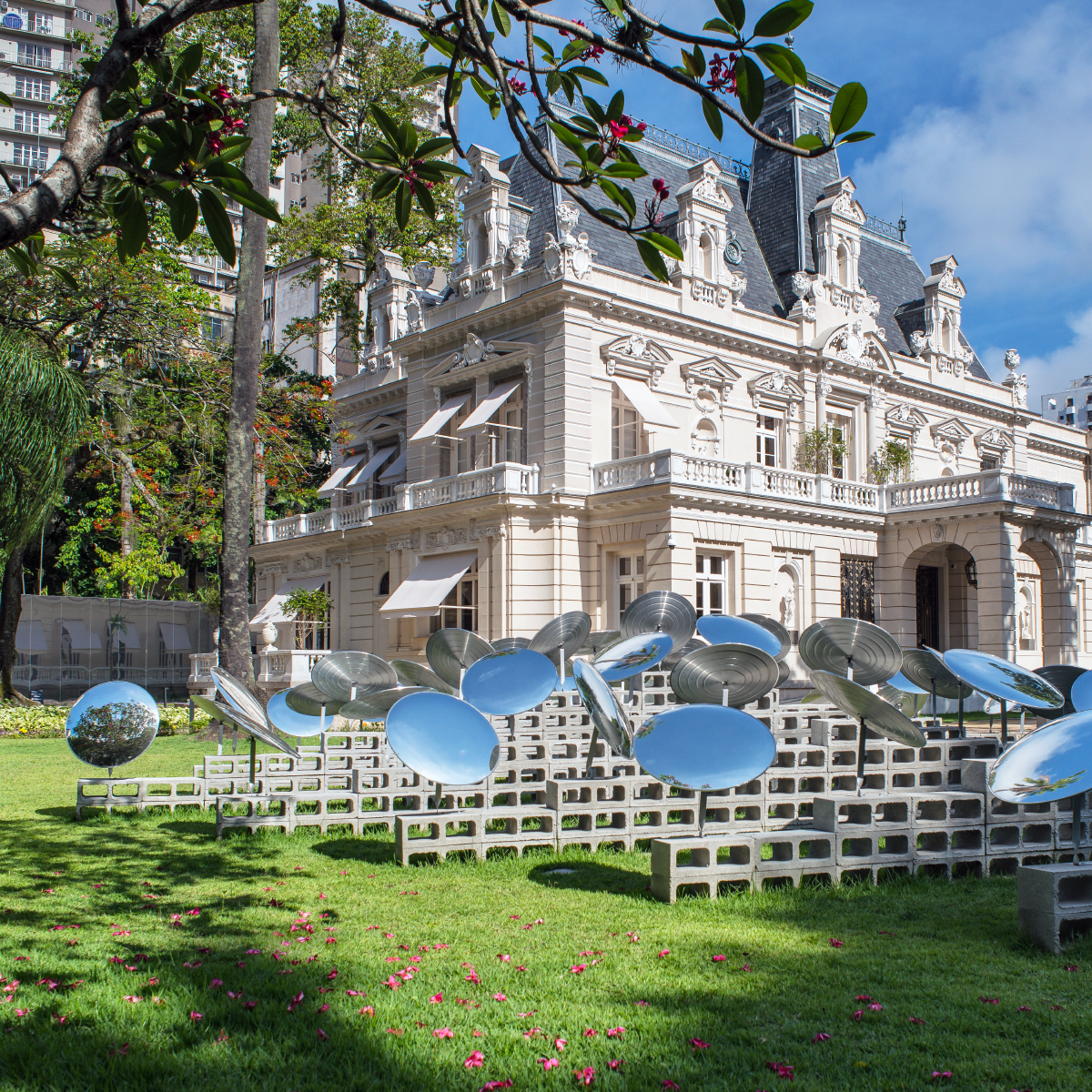
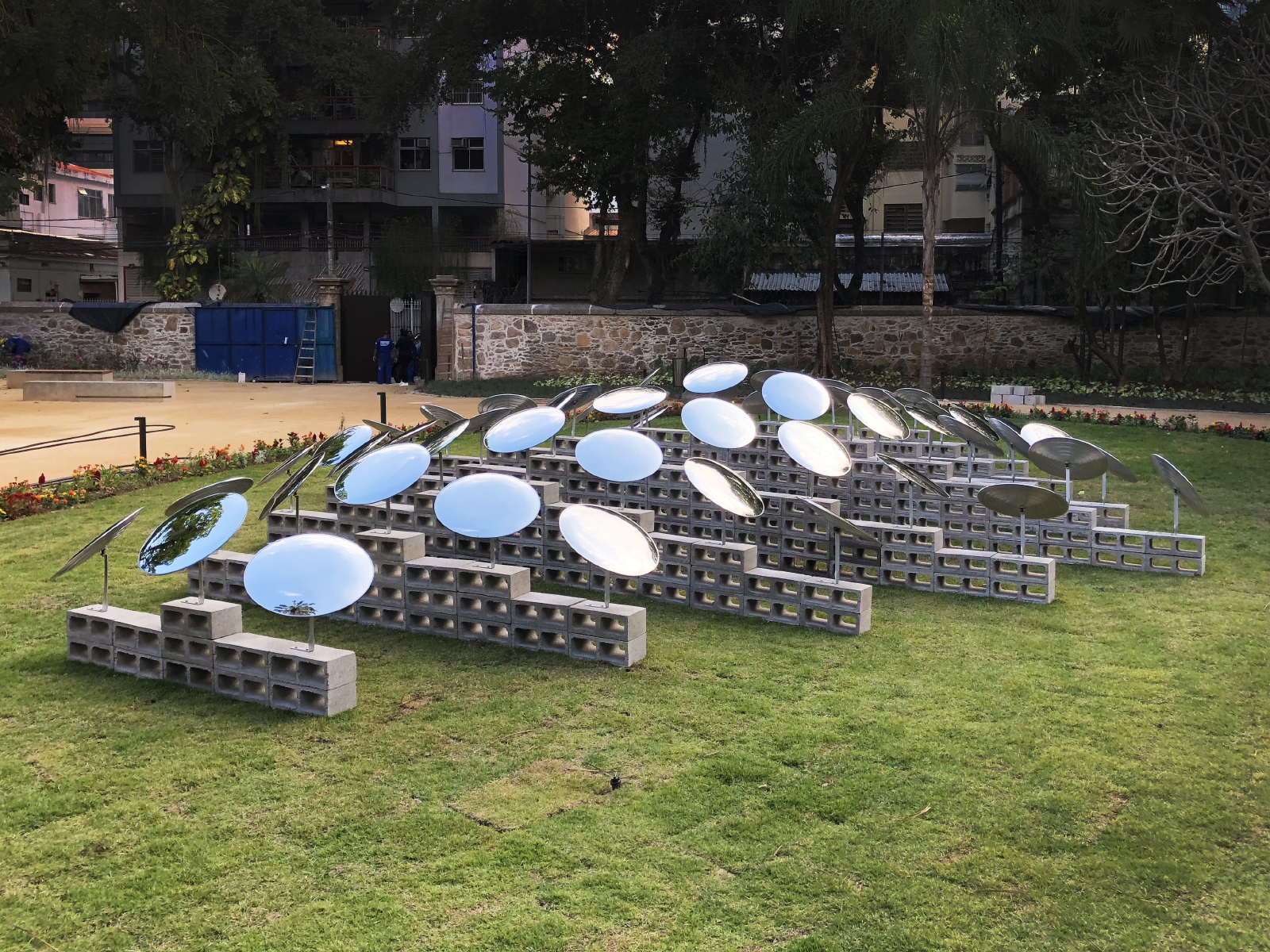
Installed in the gardens of Casa Firjan in Rio de Janeiro in 2018, Trincheiras investigates the relationships between space, architecture, landscape, and presence. The work engages with questions opened up by Neoconcretism, particularly the shift from sculpture as an autonomous form toward a spatial experience activated by the body and the participation of the viewer. At the same time, it belongs to a trajectory of contemporary sculpture marked by the incorporation of everyday and industrial materials associated with construction.

Hollow concrete blocks are stacked at varying heights, creating planes, changes in elevation, and corridors through which the public can walk. Mounted on this modular structure, circular mirrors oriented in different directions capture and fragment images of the surroundings. The sky, vegetation, architecture, and viewers themselves become part of the work, composing a landscape continually transformed by the movement of bodies, changing light, and environmental conditions.

The title Trincheiras (Trenches) introduces a tension between protection and exposure. While a trench traditionally marks and organizes territory through separation, here that logic is displaced: the corridors become spaces for circulation and encounter, while the mirrors destabilize the boundaries between interior and exterior, individual and collective, artwork and landscape.

By transforming standardized, recognizable everyday elements into a structure that is simultaneously sculptural and architectural, Trincheiras proposes an experience that extends beyond its physical form. The work is completed through the viewer’s movement and gaze, creating a topography of reflections in which observing the surrounding space also means becoming aware of one’s own presence within it.

Measure of Dispersion
(2014-ongoing) is a series of sculptural installations that aim to amplify and manipulate the spectator’s field of vision. Made from concave and convex mirrors of many sizes that Prado attaches to industrial metal structures, the sculptures create something akin to an anti-camera that reconfigures the viewer’s vantage point and amplifies notions of (dis)location.

Rather than capturing a specific moment like a camera, the mirrors reflect a fragmented body seen from uncontrollable angles and different points in space simultaneously. The resulting viewer experience is a challenge to the impulse to project preconceived assumptions onto what we see: we are made to test our sense of familiarity with our surroundings and, more importantly, with ourselves.